Enterprise AI Solutions: Strategy, Implementation, and Real-World Impact
Discover how enterprise AI solutions drive digital transformation. Learn implementation strategies, ROI metrics, and best practices for deploying AI at scale.
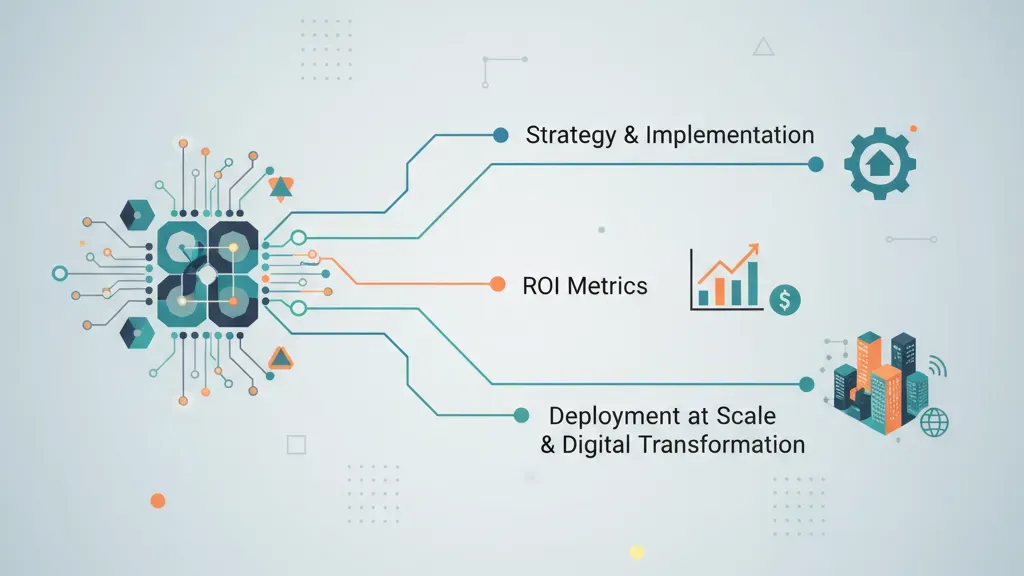
Enterprise AI Solutions: Strategy, Implementation, and Real-World Impact
The enterprise AI solutions market has grown exponentially over the past three years, with organizations across industries investing billions in artificial intelligence to drive competitive advantage, operational efficiency, and revenue growth. Yet despite this massive investment, many enterprises struggle to move beyond pilot projects and achieve meaningful, scalable AI impact.
This article explores the critical factors that separate successful enterprise AI solutions deployments from those that fail to deliver value—and provides a practical roadmap for business leaders and CTOs evaluating AI implementations.
What Are Enterprise AI Solutions?
Enterprise AI solutions are integrated systems that apply machine learning, natural language processing, computer vision, and other AI technologies to solve complex business problems at organizational scale. Unlike consumer-facing AI tools or simple chatbots, enterprise AI solutions:
- Integrate deeply with existing systems: ERP, CRM, data warehouses, accounting software, and operational databases
- Process large volumes of structured and unstructured data: Handling millions of transactions, customer interactions, and business events
- Support mission-critical decision-making: Automating workflows, predicting outcomes, and optimizing resource allocation
- Require robust governance, security, and compliance frameworks: Meeting regulatory requirements and data protection standards
- Deliver measurable ROI: Quantifiable improvements in revenue, cost, customer satisfaction, or operational efficiency
The key distinction is scope and integration. An enterprise AI solution doesn’t exist in isolation—it’s embedded into how the organization operates, processes information, and makes decisions.
The Business Case for Enterprise AI Solutions
Organizations are investing in enterprise AI solutions for three primary reasons:
1. Operational Efficiency
AI automates repetitive, high-volume tasks that would otherwise require significant human effort. Examples include:
- Invoice processing and accounts payable automation: Reducing manual data entry by 80-90% and cutting processing time from days to hours
- Customer service automation: Handling 60-70% of routine inquiries without human intervention
- Demand forecasting: Optimizing inventory levels and reducing carrying costs by 15-25%
- Predictive maintenance: Identifying equipment failures before they occur, reducing downtime and maintenance costs
A manufacturing company we worked with implemented AI-driven predictive maintenance across 150+ production assets. The result: a 35% reduction in unplanned downtime and $2.3M in annual savings.
2. Revenue Growth and Customer Experience
AI enables personalization, better decision-making, and new business models:
- Personalized recommendations: E-commerce platforms using AI recommendations see 20-30% increases in average order value
- Lead scoring and sales optimization: Identifying high-probability opportunities and optimizing sales team allocation
- Churn prediction: Identifying at-risk customers and enabling proactive retention campaigns
- Dynamic pricing: Optimizing prices in real-time based on demand, competition, and inventory levels
3. Strategic Differentiation
Organizations using advanced AI capabilities outpace competitors in innovation, speed to market, and customer insights. This is particularly critical in technology, financial services, and e-commerce sectors where AI capabilities directly influence competitive positioning.
Key Challenges in Enterprise AI Implementation
Despite the compelling business case, enterprise AI solutions face significant implementation challenges:
Data Quality and Integration
Most enterprises struggle with fragmented data across multiple systems. Implementing enterprise AI solutions requires:
- Data consolidation: Bringing together data from ERP, CRM, accounting, HR, production, and other systems
- Data quality assurance: Cleaning, standardizing, and validating data before it feeds AI models
- Real-time data pipelines: Ensuring AI models have access to current information for timely decisions
Organizations often underestimate this challenge. In our experience, 60-70% of enterprise AI projects spend more time on data preparation than on model development.
Organizational Change and Adoption
Technology is only half the battle. Enterprise AI solutions require:
- Workflow redesign: Changing how teams work, making decisions, and interact with systems
- Skill development: Training teams to work effectively with AI tools and interpret AI-generated insights
- Change management: Overcoming resistance and building organizational buy-in
- Governance frameworks: Establishing clear policies for AI use, validation, and oversight
Companies that neglect the organizational side of AI implementation see adoption rates below 30%, even when the technology works perfectly.
Model Performance and Validation
Building AI models that work in production is harder than in proof-of-concept environments:
- Data drift: Real-world data changes over time, causing model performance to degrade
- Edge cases: Models trained on historical data may fail on novel situations
- Explainability: Stakeholders need to understand why AI is making specific recommendations
- Continuous monitoring: Models require ongoing monitoring, retraining, and optimization
Cost and Time to Value
Enterprise AI solutions are not quick wins. Implementation timelines typically range from 6-18 months, with costs ranging from $500K to $5M+ depending on scope and complexity. Organizations need realistic expectations and patience.
Best Practices for Successful Enterprise AI Solutions
1. Start with High-Impact, Well-Defined Problems
Avoid the temptation to pursue “AI for AI’s sake.” Instead:
- Identify 2-3 high-impact use cases where AI can deliver significant value (10%+ cost reduction, 15%+ revenue increase, or major operational improvements)
- Ensure data exists to train models (typically 1,000-10,000+ labeled examples for supervised learning)
- Define success metrics upfront: What does success look like? How will you measure ROI?
A professional services firm we worked with initially wanted to build an AI solution for “better client matching.” Too vague. We narrowed it to: “Reduce project staffing time by 40% and improve project profitability by 20% using AI to match consultants to projects based on skills, availability, and past performance.” Clear, measurable, and achievable.
2. Build a Cross-Functional AI Team
Enterprise AI solutions require diverse expertise:
- Data engineers: Building data pipelines and ensuring data quality
- Data scientists/ML engineers: Developing and training models
- Business analysts: Translating business requirements into technical specifications
- Solution architects: Designing system architecture and integration
- Change management specialists: Managing organizational adoption
This team should report to a single leader (Chief Data Officer, VP of AI, or similar) with executive visibility and budget authority.
3. Establish Robust Data Governance
Before building models, establish:
- Data ownership: Who is responsible for each data source?
- Data quality standards: What level of accuracy/completeness is required?
- Data security and privacy: How will sensitive data be protected?
- Data lineage and documentation: Where does data come from? How is it transformed?
This investment pays dividends throughout the project lifecycle.
4. Implement Iterative, Agile Development
Enterprise AI solutions benefit from iterative development:
- Start with MVP (Minimum Viable Product): Deploy a simple version that solves 70% of the problem with 80% accuracy
- Gather feedback from real users: How does the AI perform in production? What adjustments are needed?
- Iterate and improve: Refine the model, expand scope, and add features based on real-world performance
- Measure and report ROI: Track metrics continuously and communicate value to stakeholders
This approach reduces risk and accelerates time to value compared to traditional “big bang” implementations.
5. Plan for Integration and Scalability
Enterprise AI solutions must integrate seamlessly with existing systems:
- API-first architecture: Ensure AI models are accessible via APIs that existing applications can call
- Real-time inference: Design systems that can make predictions in milliseconds, not minutes
- Scalability: Ensure the solution can handle growing data volumes and transaction loads
- Monitoring and observability: Implement systems to track model performance, data quality, and system health
6. Invest in Change Management and Training
Technology alone doesn’t drive adoption. Invest in:
- Executive sponsorship: Ensure senior leaders actively champion the initiative
- User training: Help teams understand how to use AI insights in their daily work
- Incentive alignment: Adjust performance metrics and compensation to reward AI-driven behaviors
- Continuous communication: Share successes, lessons learned, and roadmap updates regularly
Real-World Case Study: Retail Chain Optimization
A mid-sized retail chain (150+ stores, $200M annual revenue) implemented an enterprise AI solution to optimize inventory, pricing, and labor scheduling across locations.
Challenge: Fragmented systems (legacy POS, separate inventory management, manual scheduling), inconsistent pricing across stores, and excess inventory in some locations while others faced stockouts.
Solution: Implemented an integrated platform that:
- Consolidated real-time sales, inventory, and customer data from all stores
- Built predictive models for demand forecasting by location and product
- Optimized pricing dynamically based on local demand, competition, and inventory levels
- Automated labor scheduling based on predicted customer traffic
Results (12 months post-implementation):
- 18% reduction in excess inventory
- 22% improvement in inventory turnover
- 12% increase in sales (through better availability and optimized pricing)
- 8% reduction in labor costs (through optimized scheduling)
- Total ROI: 340% in year one
The key to success: Strong executive sponsorship, dedicated cross-functional team, phased rollout (starting with 30 stores, then expanding), and continuous monitoring and optimization.
Emerging Trends in Enterprise AI Solutions
1. Generative AI and Large Language Models
Generative AI is enabling new enterprise use cases:
- Intelligent document processing: Extracting information from contracts, invoices, and reports
- Customer service automation: More natural, context-aware interactions
- Content generation: Creating reports, summaries, and recommendations
- Code generation: Accelerating software development
However, generative AI also introduces new challenges around accuracy, bias, and hallucination that enterprises must carefully manage.
2. Edge AI and Distributed Inference
Rather than sending all data to centralized servers, organizations are deploying AI models to edge devices (IoT sensors, mobile devices, branch locations). This enables:
- Lower latency: Faster decision-making
- Improved privacy: Sensitive data stays local
- Offline capability: Systems work even without internet connectivity
- Reduced bandwidth: Less data transmission
3. AI Governance and Responsible AI
Enterprises are increasingly focused on:
- Model explainability: Understanding why AI made specific decisions
- Bias detection and mitigation: Ensuring AI systems don’t perpetuate discrimination
- Compliance and audit trails: Meeting regulatory requirements (GDPR, CCPA, etc.)
- Ethical AI frameworks: Establishing principles for responsible AI use
4. AI-Powered Analytics and Insights
Rather than waiting for humans to analyze data, AI automatically generates insights:
- Anomaly detection: Identifying unusual patterns in operations, finance, or customer behavior
- Root cause analysis: Understanding why specific outcomes occurred
- Prescriptive recommendations: Not just “what happened,” but “what should you do”
Evaluating Enterprise AI Solution Providers
When selecting a partner or platform for enterprise AI solutions, consider:
- Industry expertise: Do they understand your business, industry dynamics, and regulatory environment?
- Technical capabilities: Can they handle your data volume, complexity, and integration requirements?
- Implementation track record: Do they have successful case studies in your industry?
- Support and partnership model: Will they be a true partner invested in your success, or just a vendor?
- Scalability and roadmap: Can the solution grow with your needs?
- Cost structure: Is pricing transparent and aligned with value delivered?
Conclusion: The Future of Enterprise AI Solutions
Enterprise AI solutions are no longer optional for competitive organizations. The question is not whether to invest in AI, but how to do so strategically and effectively.
Successful enterprise AI solutions implementations share common characteristics: clear business focus, strong organizational commitment, investment in data and talent, iterative development, and realistic timelines. Organizations that nail these fundamentals see dramatic improvements in efficiency, revenue, and competitive positioning.
The enterprises winning with AI today are those that view it not as a technology problem, but as a business transformation challenge—requiring equal investment in technology, talent, processes, and organizational change.
At Manaira Labs, we help enterprise organizations navigate this transformation. Whether you’re evaluating AI solutions, building implementation strategies, or optimizing existing AI deployments, our team of AI strategists and engineers can guide you through the critical decisions and execution challenges.
Ready to explore how enterprise AI solutions can transform your business? Contact Manaira Labs to discuss your AI strategy and implementation roadmap.