How to Choose the Right AI Consulting Partner in Indonesia: A Decision Framework
A practical decision framework for selecting the right AI consulting partner in Indonesia. Learn how to evaluate capabilities, assess implementation experience, and avoid common pitfalls when choosing an AI strategy partner.
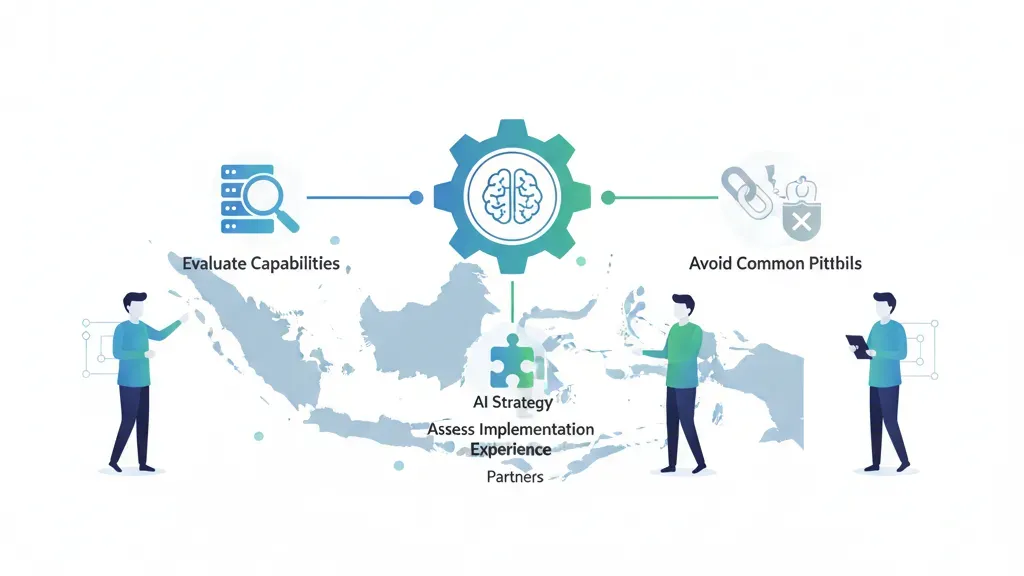
How to Choose the Right AI Consulting Partner in Indonesia: A Decision Framework
Artificial intelligence is no longer a distant future technology—it’s reshaping Indonesian businesses today. Yet the gap between AI hype and successful implementation remains enormous. According to industry surveys, over 60% of AI projects fail to move beyond proof-of-concept stage, often because organizations selected the wrong consulting partner to guide their journey.
Choosing the right AI consulting Indonesia provider isn’t about finding the firm with the most impressive pitch deck or the longest client list. It’s about finding a partner who understands your specific business context, has real implementation experience, and can deliver working systems—not just strategy documents gathering dust on a shelf.
This guide walks you through a decision framework designed for CTOs, procurement teams, and business leaders evaluating AI consulting firms in Indonesia.
Why the Choice of Consulting Partner Matters
Before diving into evaluation criteria, it’s worth understanding what’s at stake. A poor consulting partnership can result in:
- Wasted budget: Millions spent on strategy that never gets implemented
- Delayed transformation: Months lost to vendor lock-in with tools that don’t fit your needs
- Team frustration: Your technical team loses confidence when external advisors overpromise and underdeliver
- Missed competitive advantage: While your competitors ship AI, you’re still in planning mode
The right partner, conversely, accelerates your AI journey by combining strategic thinking with hands-on execution capability. This matters especially in Indonesia’s fast-moving market, where first-mover advantage in AI-powered customer service, supply chain optimization, or fraud detection can determine competitive positioning.
Step 1: Clarify Your AI Needs Before the Sales Call
Many organizations start by looking at consulting firms before they’ve clearly defined what problem AI should solve. This is backwards.
Begin internally with three critical questions:
What business outcome are you pursuing? Not “implement AI”—that’s vague. Instead: “Reduce customer support costs by responding to 80% of inquiries automatically,” or “Detect fraudulent transactions in real-time to prevent losses,” or “Forecast demand for inventory optimization.”
What data do you have? AI requires fuel. Do you have clean, historical transaction data? Customer interaction logs? Production metrics? Consulting firms often find that clients underestimate data quality issues. The partner you choose should probe this ruthlessly, not promise miracles with incomplete data.
What’s your timeline and budget? Enterprise AI implementations in Indonesia typically run 6-12 months and cost Rp 500M to Rp 5B+, depending on scope. If you’re expecting a solution in 2 months for Rp 50M, the wrong consultant will take your money anyway. The right one will tell you why that’s unrealistic.
Frame these answers in writing before you engage vendors. This clarity prevents vendor selection from becoming a beauty contest.
Step 2: Assess Real Implementation Experience
This is the most important filter. A consultant can talk strategy beautifully—but can they actually build AI systems?
When evaluating AI strategy consulting and implementation capabilities, look for:
Delivered Systems, Not Just Reports: Ask to see examples of AI systems they’ve actually deployed in production. Not pilots. Not proofs-of-concept. Systems running right now, solving real problems. If they hesitate or say “we’re an advisory firm,” that’s a yellow flag.
Ask specifically:
- What AI/ML models are currently running in production for your clients?
- How many months of live operation? (At least 6 months of live performance data is meaningful.)
- What was the business impact? (Quantified: cost reduced, revenue increased, time saved)
- What team built it—internal staff or subcontractors?
Indonesian Market Experience: Global consulting firms bring frameworks, but local context matters. Understanding Indonesian payment systems (QRIS, GoPay), marketplace integration (Tokopedia, Shopee, Lazada), and UMKM-specific workflows isn’t theoretical—it shapes implementation strategy.
A good Indonesian AI consulting partner will reference case studies in retail, F&B, logistics, or manufacturing—industries that dominate Indonesia’s SME market. They’ll understand data privacy regulations (UU PDP), compliance requirements, and local deployment preferences.
Technical Depth on Your Use Case: If you’re evaluating a chatbot partner, they should be able to discuss:
- Intent classification models they’ve used
- How they handle Indonesian language nuances
- Integration with WhatsApp Business API
- Real response latency they’ve achieved in production
- Cost per message at scale
If they’re vague or pivot to talking about “platforms,” they haven’t built this before.
Step 3: Evaluate the Partnership Model
How will they work with your team?
The best consulting engagements are co-creation models, not black-box vendor relationships. You want a partner who:
- Transfers knowledge: Your team should graduate from the engagement more capable, not more dependent
- Collaborates closely with engineering: Too many “strategy” consultants hand over recommendations that your engineers can’t or won’t execute
- Stays involved in implementation: The consultants who design the solution should be present during build and deployment, not disappear after the spec is written
- Builds with production in mind: Not just academic models, but systems designed for your infrastructure, compliance requirements, and operational constraints
Ask directly: “Will the same team that designs the solution oversee implementation? If not, how do you prevent knowledge loss?”
Step 4: Assess Vendor Lock-In Risk
One critical mistake: choosing a consulting firm that requires their proprietary platform to implement AI solutions.
Red flags include:
- “You’ll need our platform to scale this”
- Pricing models that tie your costs to their usage metrics forever
- Architectural decisions that make it difficult to switch platforms later
- Unwillingness to use your preferred cloud provider (AWS, GCP, Azure)
The best partners in enterprise AI solutions work tool-agnostic. They recommend the right infrastructure for your needs, not their preferred vendor. This gives you optionality and prevents locked-in economics.
Step 5: Check References Methodically
Don’t just read case studies on their website. Actually call three to five clients who’ve completed implementations.
When you call, ask:
- “Did they deliver what they promised, on time and within budget?”
- “What would you do differently in retrospect?”
- “How involved are they post-launch? Can you still call them?”
- “What surprised you negatively about working with them?”
- “Would you hire them again?”
Listen for frustration in the pauses. If a reference says “great team, but the project ran 6 months longer than planned and costs doubled,” that’s useful signal.
Step 6: Evaluate the Team Composition
Who will actually work on your project?
- Partner/Principal: Drives strategy, manages relationship, sets direction
- AI/ML engineers: Build models, handle data pipelines, optimize performance
- Software engineers: Integrate with your systems, manage deployment, handle production issues
- Project manager: Coordinates across your team and theirs
Best practice: insist on seeing resumes of the core team, not just company capabilities. One former head of data science at a major bank carries more weight than five “AI consultants” with 2 years of experience.
Also understand: if your partner is 15 people, you probably aren’t their focus. If they’re 500+, implementation support becomes inconsistent. Sweet spot: 30-100 person firm where you’re a meaningful client.
Step 7: Clarify Success Metrics and Contracts
Before signing, you need explicit agreement on what success looks like:
- Delivery criteria: Model accuracy? Response time? Cost per inference? Make it quantifiable.
- Performance SLAs: What uptime guarantee? What support response time if systems fail?
- Timeline gates: When does phase 1 deliver? Phase 2? What happens if milestones slip?
- Knowledge transfer: By project end, who owns the code? Can your team modify it independently?
- Post-launch support: How many months of maintenance are included? What’s the cost structure after?
Avoid open-ended statements like “deliver an AI solution.” Specify the behavior you expect from that solution in production.
Common Red Flags When Selecting an AI Partner
- Over-promising on timeline or budget: “We can have this in 3 months” when similar projects take 9-12 is a sign they’re selling, not being realistic
- No production systems: If they can’t show you live, running systems, they’re theorists, not builders
- Dismissing your data quality concerns: Bad data is the #1 blocker in AI projects. A consultant who glosses over it hasn’t seen enough failures
- Not asking hard questions: A good consulting partner should challenge your assumptions, not just validate them
- One-size-fits-all approach: “Every company needs a chatbot” or “Everyone should start with a BI dashboard”—this is reductive
- No Indonesian regulatory knowledge: If they can’t discuss compliance, data residency, or local requirements, they haven’t worked in your market
- Unclear team involvement: If they can’t commit the same people you met to your project, renegotiate
- Dismissing your tech stack: “We only work with cloud platforms” or “You need to migrate to our preferred tech”—this is inflexibility
The Manaira Labs Approach to Partnering
At Manaira Labs, we approach custom AI solutions Indonesia differently.
We don’t position ourselves as pure strategists. We’re builders. We built Bicara, an AI platform serving Indonesian SMEs, which means we’ve solved the same problems your team faces: integrating with local payment systems, handling WhatsApp messaging at scale, designing AI agents that work with imperfect data, complying with Indonesian regulations.
When we consult, we bring:
-
Production experience: Every recommendation we make, we’ve either built or seen built in production. No theory-only consulting.
-
Deep Indonesia context: We understand UMKM workflows, marketplace integrations, local compliance. We’ve built product for this market.
-
Implementation partnership: We don’t hand off specs. We build alongside your team, transfer knowledge, and stay involved through launch.
-
Build-and-scale mentality: Our goal is to get your AI system live in production, delivering value—then optimize from there. Not endless planning.
Our typical engagement: 6-8 weeks from strategy kickoff to production deployment. We’ve found that most organizations don’t need a 12-month planning process; they need clarity, focus, and a execution partner.
Decision Checklist: Scoring Your Options
To make this concrete, here’s a scoring framework:
| Criterion | Weight | Manaira Partner A | Manaira Partner B |
|---|---|---|---|
| Production systems deployed | 25% | 9/10 | 4/10 |
| Indonesia market expertise | 20% | 10/10 | 5/10 |
| Team you’ll actually work with | 20% | 9/10 | 6/10 |
| Reference quality (calls made) | 15% | 8/10 | 7/10 |
| Clear success metrics | 10% | 9/10 | 5/10 |
| Weighted Score | 100% | 8.95/10 | 5.5/10 |
The firm with higher production experience and clearer implementation partnerships will outperform on AI outcomes.
Conclusion: Choose the Partner, Not the Pitch
The best AI consulting partnerships are built on alignment, experience, and realistic expectations—not marketing polish.
Before you sign an engagement letter, ensure:
✓ You understand what business outcome you’re pursuing
✓ The partner has delivered similar systems in production
✓ They have real Indonesia market experience
✓ The team you meet will actually work on your project
✓ You can speak to references who’ve completed projects
✓ Success metrics are defined and contractually binding
✓ Implementation support extends beyond the strategy phase
If you’re evaluating options for AI implementation in Indonesia, we’d welcome a conversation. Reach out to Manaira Labs—we can discuss your specific challenges and whether a partnership makes sense.
Ready to move from AI strategy to actual working systems? Contact Manaira Labs to discuss your implementation roadmap. We build AI that works in production. From strategy to deployed AI agents in 6-8 weeks.
Manaira Labs builds production AI for Indonesian organizations. We’re builders first, advisors second—and our track record shows it.